Choosing your wedding planner is arguably the single most important decision you will make for your destination wedding in Puerto Vallarta. This one choice sets the stage for everything else. The right planner isn't just another vendor; they are your creative partner, budget strategist, and on-the-ground advocate. This decision is the ultimate investment in your wedding's success and, just as importantly, your own peace of mind.
Why the Right Wedding Planner is a Game-Changer
Your Puerto Vallarta wedding is more than an event—it's a core memory in the making. The path to that day can be a maze of stress and second-guessing, or it can be a genuinely exciting and creative journey. The difference is the professional you hire to lead the way.
A great planner is far more than a "day-of" coordinator. From day one, they are your advocate, your toughest negotiator, and your go-to problem-solver. Think of them as the architect and general contractor for your dream day. You wouldn't build a custom home without an expert at the helm, and orchestrating a complex, international event is no different. Their entire role is to translate your vision into a living, breathing, flawlessly executed reality.
The True Value of Boots-on-the-Ground Expertise
When planning from thousands of miles away, a local planner's value is immeasurable. They possess an intimate, nuanced understanding of the Puerto Vallarta, Riviera Nayarit, and Punta Mita areas that you simply cannot find through a Google search. This insider knowledge directly impacts your entire wedding experience.
- Vetted Vendor Network: An established planner has a curated list of the best-of-the-best—florists who know which blooms withstand coastal humidity, photographers who master tropical light, and caterers who deliver consistently. These relationships often mean better pricing, priority service, and a team that works seamlessly together.
- Logistical Wizardry: They anticipate and solve problems you don't even know exist yet. This includes navigating local permits, understanding unique supplier payment cultures, or arranging guest transportation on winding coastal roads. It's these details that can derail a wedding if overlooked.
- Cultural Fluency: A great local planner effortlessly bridges any language or cultural gaps, ensuring nothing is lost in translation and all local legal and cultural details are handled perfectly.
A top-tier planner doesn't just save you time; their vendor connections and negotiation skills often save you a significant amount of money. The exclusive rates and value-adds they secure can easily offset a large portion of their fee, making their expertise a sound financial decision.
Your Shield Against the Unexpected
Let’s be realistic: every wedding has potential for hiccups, and for a destination event, the stakes are higher. What is the plan if a surprise tropical storm rolls in an hour before your beach ceremony? What if a key vendor gets stuck in traffic? This is precisely where a planner’s crisis-management skills become priceless.
An experienced planner has seen it all and has a backup plan for their backup plan. They are the calm in the eye of the storm, resolving issues before you are even aware of a problem. This empowers you to be completely present, soaking in every moment with your loved ones instead of managing logistics. Their job is to manage the chaos so you can experience the joy.
Ultimately, figuring out how to choose a wedding planner is about finding a true strategic partner. This person will be deeply involved in one of the most significant moments of your life. The connection must go beyond a contract—it needs to be built on trust, a shared vision, and genuine chemistry. This guide provides the framework to find that perfect match, ensuring your journey to "I do" is as beautiful as the day itself.
Clarifying Your Wedding Vision and Budget
Before you begin interviewing planners, you and your partner must get on the same page. This is the most crucial conversation you will have. What do you truly want for your wedding day? A great planner can work magic, but they need a blueprint to start from. Without a shared vision, you are spinning your wheels, and they are flying blind. This initial clarity is the foundation for everything that follows.
From Vague Dreams to Actionable Vision
Let's move beyond "a fun beach party." That's a starting point, not a vision. Sit down together—without distractions—and discuss what truly matters to you both. Is the top priority an unforgettable guest experience with incredible food and an open bar? Or are you focused on capturing the moment with show-stopping photography and a cinematic video? You have to decide what gets the prime real estate in your budget and focus.
This is about defining your priorities. A couple wanting a high-energy dance party with a well-known DJ requires a planner with a different network than a couple dreaming of an intimate, multi-course gourmet dinner for 30 guests. Knowing what you value most is the secret to finding a planner who specializes in those areas. This decision tree illustrates how your core needs can point you toward the right type of planner.
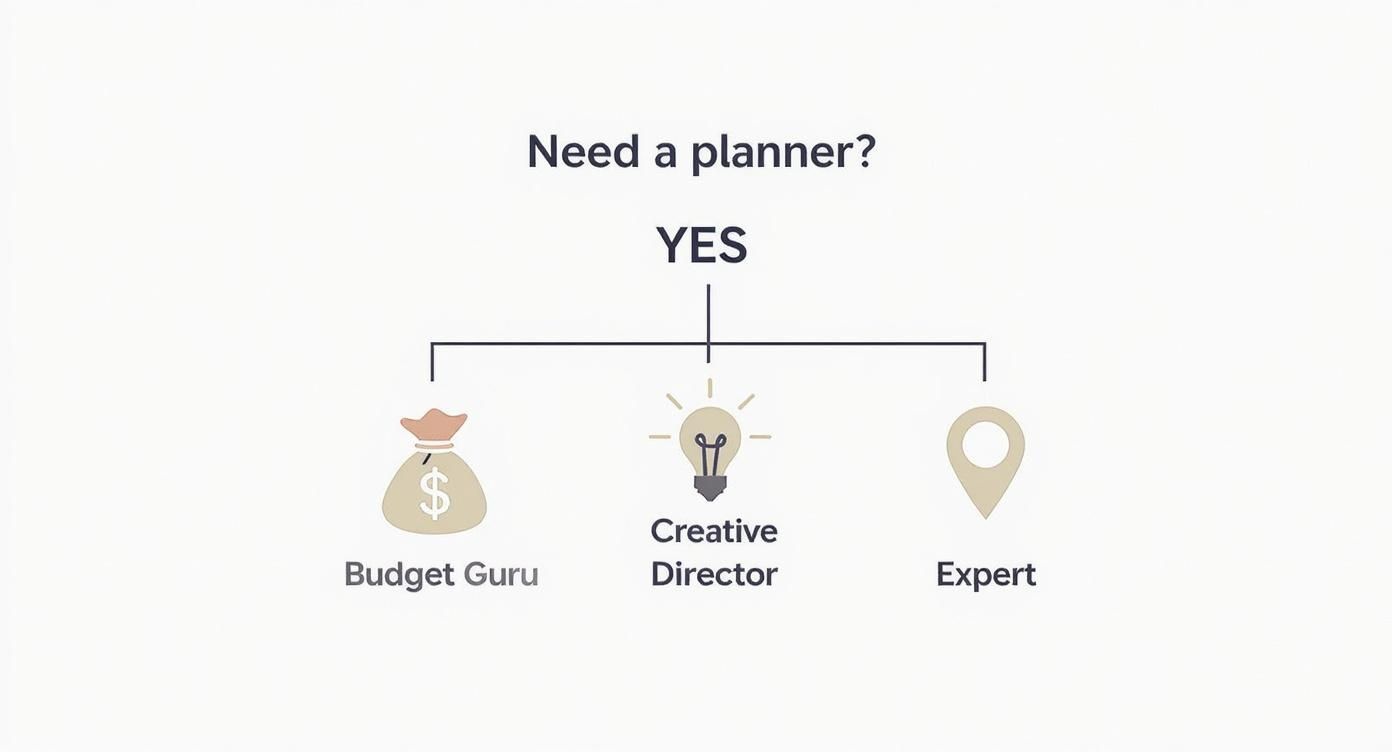
As you can see, whether you need a financial guru, a creative visionary, or a logistics mastermind should shape your search from the very beginning.
Establishing Your Budgetary Guardrails
Now, let's address the budget. This number is the single most important piece of information you will give a planner. It dictates everything: venue options, guest count, vendor choices, and overall scope. Think of your budget not as a limitation, but as a powerful tool. A realistic, honest number empowers a good planner to get creative and make smart, strategic decisions on your behalf. Be upfront about your total investment from the first call. A true professional will respect your number and immediately begin strategizing how to maximize its value.
To make your initial consultations highly productive, work through these questions first and have your answers ready:
- Guest Count: What is your realistic estimated guest count? This drives nearly every other cost.
- Top Three Priorities: If you could splurge on only three things, what would they be? (e.g., food & beverage, photography, live band).
- The Vibe: What three words describe the feeling you want to create? (e.g., "romantic, relaxed, elegant" or "vibrant, modern, epic").
- Non-Negotiables: What is the one element you absolutely will not compromise on?
- Budget Comfort Zone: What is the total, all-in figure you are comfortable spending, including planner fees?
Answering these questions transforms your search. You're no longer just looking for "a wedding planner." You are searching for an expert who specializes in executing a 100-guest, modern-luxe wedding with a focus on phenomenal food and music. That specificity is a target you can hit. This preparation allows you to enter interviews as a unified team, making it far easier to find the perfect partner to bring your vision to life.
How to Interview and Vet Your Top Candidates
A beautiful portfolio is an excellent start, but it is only a start. The real insight comes from the interview process. This is your opportunity to look beyond the picture-perfect gallery and understand how a planner actually works. Think of this not as an interrogation, but as a conversation to determine if you have found the strategic partner who can execute your Puerto Vallarta wedding vision.

You are not just evaluating experience on a resume. You are searching for genuine chemistry, a transparent communication style, and a problem-solving attitude that puts you completely at ease.
Questions That Reveal True Expertise
Let's move beyond the basics. Any planner can claim to be organized. Your goal is to ask questions that require them to demonstrate their expertise with real-world examples relevant to your wedding. Scenario-based questions are your most effective tool. Instead of asking, "Are you good with budgets?" frame it this way: "Our budget is $X, and our top priority is an incredible culinary experience for our 80 guests. Walk us through how you would select vendors to achieve that while keeping us on track." This single question shifts the dynamic from a simple yes/no to a live demonstration of their strategic thinking.
A planner’s initial reaction to your budget and priorities is telling. The right professional will immediately start brainstorming creative solutions and share in your excitement, not just list what you can't afford. They should make you feel empowered, not restricted.
As you prepare for these conversations, understanding the industry context is helpful. The global wedding planning market is projected to reach $106 billion by 2025, and with 85% of couples using digital tools for planning, a planner's online presence is a key indicator of their relevance. You can find more wedding planning statistics that highlight the importance of this digital-first mindset.
Key Interview Questions for Your Potential Planner
A list of targeted questions to ask during consultations to reveal a planner's expertise, style, and suitability for your Puerto Vallarta wedding.
| Question Category | Sample Questions to Ask |
|---|---|
| Experience & Style | "Can you describe the most challenging wedding you've planned in Punta Mita and what you learned?" "How would you describe your signature planning style in three words?" |
| Budget Management | "How do you handle unexpected costs? Can you give me an example?" "What percentage of the budget do you typically allocate for a contingency fund?" |
| Vendor Network | "Who are your go-to photographers for a beachfront ceremony, and what makes them your top choice?" "Tell me about your relationship with the event manager at [Your Dream Venue]." |
| Communication & Process | "What is your preferred method of communication? How often can we expect updates from you?" "What does your planning timeline look like from now until the wedding day?" |
| Problem-Solving | "Imagine our florist cancels a week before the wedding. What is your immediate action plan?" "How do you handle disagreements between vendors or family members on the wedding day?" |
These questions are conversation starters, not just a checklist. Pay close attention to how they answer, not just what they say. Their responses should instill a clear sense of confidence and expertise.
Gauging Their Local Network and Problem-Solving Skills
For a destination wedding in Puerto Vallarta, a planner’s local connections are non-negotiable. Their relationships with venues, florists, photographers, and transportation companies are what create a seamless experience. Be specific in your questioning. If you are dreaming of a venue like Villa Experience or Martoca Beach Garden, ask about their direct experience there.
- Venue-Specific Knowledge: "We love the vibe of [Specific Venue]. Can you tell us about a challenge you've solved there?"
- Vendor Relationships: "Who are your top three florists in Riviera Nayarit for a modern, tropical style, and why do you recommend them?"
- Crisis Management: "Nightmare scenario: our custom welcome bags get stuck in customs two days before guests arrive. What are your first three calls?"
These questions reveal their real, on-the-ground resourcefulness. You want a planner with strong, trusted partnerships, built over years of successful events.
The Art of Checking References
Checking references is a crucial step, but it must be done correctly to yield honest feedback. Do not just ask if the couple was happy. Ask detailed questions that encourage them to share their experience.
Key Takeaways from Reference Checks:
- Communication Style: Ask how proactive the planner was with updates. Did the couple feel informed and prioritized throughout the process?
- Budget Management: Inquire about how the budget was handled. Were there any surprise costs, and how were they addressed?
- The Wedding Day: Ask for a specific example of when the planner went above and beyond on the wedding day.
- Final Verdict: A powerful question is, "If you could do it all over again, is there anything you would ask them to do differently?"
The answers will provide a much richer story than a polished website testimonial ever could, helping you make a final choice with total confidence.
Diving into Contracts and Fee Structures
Let's discuss the business side of planning: the contract. While not the most glamorous part, this document is your best friend. A solid contract is more than a legal formality; it's the foundation of a great partnership. It transforms a leap of faith into a confident stride forward. Signing on the dotted line should bring a sense of relief and excitement, not anxiety. Getting this right ensures total transparency, with no surprises or hidden fees down the road.
How Planners Get Paid: Decoding the Fee Structures
In the wedding planning industry, you will typically encounter three common fee structures. No single model is "best"; it's about finding what aligns with your specific wedding, vision, and budget.
- Percentage of Your Budget: A classic model, especially for large-scale, complex weddings. The planner’s fee is typically 15-20% of your total wedding cost. This model scales with the scope of work. A great planner will always prioritize your vision and suggest vendors based on fit, not a higher price tag.
- Flat Fee: This is my personal favorite for its clarity. After an initial deep-dive consultation, I can provide a single, fixed price for my services. It's clean, simple, and excellent for budgeting, as you know the exact cost regardless of minor fluctuations in vendor expenses.
- Hourly Rate: This is less common for full-service planning but is perfect for couples needing a few hours of expert consultation or help with specific tasks. It's great for targeted problem-solving but can be difficult for budgeting a full wedding.
Choosing a fee structure is a critical step in deciding how to choose a wedding planner. Do not be shy about asking for a detailed breakdown. A flat-fee proposal should still itemize every included service, and a percentage-based fee should clearly define which budget items it applies to.
The Must-Haves for Your Contract Checklist
Once you’ve settled on a fee structure, the contract makes it official. A true professional will provide a document that is clear, thorough, and easy to understand. A vague contract that requires a lawyer to translate is a major red flag. Think of your contract as the official roadmap for your planning journey.
Key Contract Takeaways:
- A Detailed Scope of Services: The contract must explicitly list everything the planner will do, from sourcing vendors to running the wedding day schedule. It should also clearly state what is not included.
- A Clear Payment Schedule: This section should detail the total fee, the initial deposit required to secure your date, and the due dates for all subsequent payments.
- Cancellation and Postponement Policies: The contract must protect both parties by clearly outlining policies for these "what if" scenarios, including any non-refundable fees.
- Contingency Plans: This is especially crucial for a destination wedding. The contract should address how uncontrollable events, like severe weather or travel disruptions, will be handled.
The average U.S. wedding costs between $33,000 and $36,000, with that figure easily rising to $65,000 or more in high-end markets. You can see how your budget stacks up with more industry stats on Wedfluencer. Your planner's fee is a significant part of this investment, and a rock-solid contract is how you protect it. A great contract builds trust and paves the way for a planning process that is smooth, collaborative, and genuinely enjoyable.
Spotting Red Flags and Trusting Your Instincts
After the interviews, portfolio reviews, and contract analysis, the final decision often comes down to your gut instinct. A planner can look perfect on paper, but if something feels off, you must listen to that feeling. This isn't about paranoia; it's about being discerning and protecting your peace of mind.

Sometimes the most crucial signals are not the facts you see but the subtle vibes you perceive. Your intuition is an incredibly powerful tool in this process, guiding you toward a partnership that feels genuinely right and secure.
Common Warning Signs You Cannot Ignore
Red flags in the wedding industry are often subtle hints of larger potential problems. Stay vigilant for these signs during your consultations.
- Lagging Communication: If they take days to reply to your initial inquiry or are late for calls, imagine the radio silence during peak planning. Prompt, professional communication is a baseline requirement, not a bonus.
- Reference Hesitation: A confident, seasoned planner is proud of their work and eager for you to speak with past clients. Dodging this request is a major cause for concern.
- Pushy Sales Tactics: You should never feel pressured into signing a contract. A true professional wants you to be 100% confident in your decision, not rushed into it.
- Dismissing Your Vision (or Budget): A planner who scoffs at your budget or imposes their aesthetic is not a partner. The right professional respects your vision and financial boundaries, finding creative ways to work within them.
Confidence vs. Ego: Know the Difference
There is a vast difference between a confident expert and an ego-driven one. A confident planner listens attentively, offers insightful guidance, and collaborates with you to elevate your vision. Their mission is to bring your dream to life. An ego-driven planner may steamroll your ideas or dismiss your concerns, presenting their way as the only way.
Your wedding planner should be your biggest advocate. If a conversation leaves you feeling insecure or unheard, that is your gut telling you this is not the right fit, no matter how impressive their portfolio. You need a supportive partner who makes you feel excited, not someone you must constantly battle to be heard.
Vendor Networks and Hidden Agendas
A planner’s vendor network is one of their most valuable assets, but it must be built on quality and trust, not kickbacks. A planner who is completely rigid with their vendor list, refusing to even consider a photographer you love, is a red flag. While planners have trusted partners for a reason—reliability and quality—they should also be flexible. They should be able to explain why they recommend a vendor specifically for your style, budget, and personality.
Today’s planners navigate a landscape where 48% of couples cite managing budget expectations as a key challenge. A great planner addresses this head-on with honesty and creative solutions. You can read more about [the challenges planners are navigating right now on WPIC.ca](https://wpic.ca/business of-weddings/challenges-wedding-planners-are-facing-in-2025-and-how-to-overcome-them/).
Ultimately, choosing a planner is a massive act of trust. Listen to that quiet inner voice. The right person will not only have the professional expertise but will also give you the priceless feeling of being completely and totally cared for.
Answering Your Final Questions
As you near a decision, a few key questions often arise. This is completely normal! Getting these final details clarified will give you the confidence to move forward and officially begin the exciting part of planning. Let's address the most common questions couples ask right before they commit.
When Should We Actually Hire Our Planner?
For a destination wedding in Puerto Vallarta, the answer is simple: as soon as possible. The moment you have a rough idea of your desired wedding season and location is the time to start your search. Bringing a planner on board before you book a venue is one of the smartest strategic moves you can make. A seasoned local planner knows the venues inside and out—including private villas and hidden gems you won't find online—and can help you secure better dates and pricing.
A key takeaway here is that a planner's first job is to help you build a realistic budget. Hiring them early prevents you from falling in love with a venue or concept that doesn't align with your finances, saving you from potential disappointment.
What’s the Real Difference Between a Planner and a Venue Coordinator?
Understanding this distinction is critical to your wedding experience. While both roles are valuable, they serve different functions. A venue coordinator works for the venue; their primary loyalty is to their employer. They ensure the venue's rules are followed and its services (like catering and staffing) are delivered. They are an asset, but they do not work for you.
Your wedding planner works exclusively for you. We are your advocate, creative partner, and logistical lead for every single aspect of your wedding. Our loyalty is 100% to you and your vision.
- Venue Coordinator's World: Manages venue-specific logistics like catering, bar staff, and basic room setup.
- Wedding Planner's Universe: Manages your entire vision, budget, vendor team, guest travel, and all details from the welcome party to the farewell brunch.
Think of your planner as the director of the entire movie, while the venue coordinator manages one important filming location.
How Do We Budget for a Planner?
View your planner not as a cost, but as an investment in your peace of mind and the overall success of your wedding. In the Puerto Vallarta and Riviera Nayarit area, planners typically charge either a flat fee or a percentage of your total wedding budget, usually between 15% and 20%. The final number depends on the scale and complexity of your celebration.
Be completely transparent about your total budget from the first conversation. A true professional will use that number to show you what is possible and how their expertise and vendor relationships can actually stretch your budget further, often saving you more than their fee in the long run.
What if We Don’t Like One of Their Ideas?
This is an excellent question that gets to the heart of the planner-client relationship. You won't love every single idea, and that is perfectly okay. Honest feedback is essential to the creative process! If a planner suggests something that doesn't feel like "you," simply say so. A good planner will never get defensive. Instead, they will be eager to hear your thoughts and immediately begin brainstorming alternatives you will love.
This is why finding someone you "click" with is so crucial. Our job is to bring your vision to life, not our own. We provide the experience and the know-how, but you and your partner always have the final say. It is your day and your story, and you should feel incredible about every single choice you make.
Choosing the right partners is the first step to a flawless destination wedding. At Vallarta Wedding Planners, we’ve already done the hard work of vetting the absolute best vendors in the region—from photographers to florists and everything in between. Explore our curated network of professionals who are ready to bring your vision to life. Discover your dream wedding team with Vallarta Wedding Planners today.
Article created using Outrank