Finding the perfect wedding venue is the most significant decision you'll make in your planning journey. Before you get swept away by stunning online galleries, let's establish a crucial fact: this isn't about finding the prettiest place. It's about finding the right place for your budget, guest list, and vision. This guide is for couples ready for actionable, budget-conscious advice to confidently select a venue that feels like a true extension of their story.
Getting your foundation right before you start your search is the single most effective way to save time, avoid stress, and prevent the heartbreak of falling for a venue that simply won't work. This is the expert-led process to ensure you make a choice you'll love for years to come.
Start Your Venue Search with a Clear Vision
As a wedding planner, I've seen it happen countless times: a couple tours a breathtaking location, falls deeply in love, and then confronts the reality that it's double their budget or can only seat half their guests. Let’s bypass that disappointment by starting with a clear, strategic plan.
This initial work isn't about limiting your dreams; it’s about giving your search powerful direction. Think of it as creating the blueprint for your wedding day. Every decision that follows—from catering to floral design—will hinge on the venue you select.
Let's build your foundation with three non-negotiable pillars.
| Key Decision | What to Define | Why It's Critical |
|---|---|---|
| Budget | A firm, all-in number for the venue, food, and beverage. | This immediately narrows your options to what's financially realistic, preventing wasted time and emotional energy. |
| Guest Count | A realistic, near-final number of attendees. | Venue capacity is a hard limit. This number dictates the physical size of the space you require. |
| Style & Vibe | The overall feeling and aesthetic you envision for your day. | This ensures the venue's atmosphere aligns with your personalities and the narrative you want to create. |
Having these answers transforms a potentially overwhelming search into a focused, intentional mission.
Nail Down Your Wedding Budget First
Let's address the most critical element first: your budget. This can be a challenging conversation, but it is, without question, the most important one. You must know your numbers before you look at a single property.
Sit down with everyone contributing financially and establish a final, total wedding budget. From there, a sound industry standard is to allocate 40-50% of your total budget for the venue and catering combined. These are consistently the largest expenses in any wedding.
Don't stop at the advertised rental fee. I've seen sticker shock derail many couples. Be prepared for service charges (often 20-25%), taxes, and gratuities that can significantly increase the final bill. Always build this buffer into your calculations to get a true cost estimate.
Finalize a Realistic Guest Count
Your guest count is the next major piece of the puzzle. It's a simple logistical reality: a venue with a maximum capacity of 150 cannot safely accommodate your guest list of 200. It is far better to make tough decisions on your list now than to face an impossible situation later.
A practical method is the A-B-C list approach.
- A-List: The absolute must-haves, your non-negotiable attendees.
- B-List: The people you would love to invite if space and budget allow.
- C-List: A "nice-to-have" list if circumstances change.
Every single person you invite adds to your costs—not just for their seat, but for their meal, drinks, and even the postage for their invitation. Cutting just 10 people from your list can easily save over $1,000, which could be the difference that puts your dream venue within reach. The latest data from Wedfluencer.com shows the average U.S. wedding hosts around 116 guests, with budgets between $33,000 to $36,000.
Define Your Wedding Style and Vibe
Finally, how do you want your wedding day to feel? The venue serves as the canvas for your entire event. Its inherent style sets the tone for everything from the dress code to the decor.
Take a moment to visualize your celebration.
- Timeless & Elegant? Envision a historic estate with manicured gardens, a grand ballroom with crystal chandeliers, or a sophisticated country club.
- Laid-back & Organic? Think about a rustic barn with exposed wood beams, a vineyard overlooking rolling hills, or a lush, bohemian-style garden.
- Modern & Urban? Picture an industrial loft with exposed brick, a contemporary art gallery, or a chic rooftop restaurant with skyline views.
This is where you can start having fun. Create a shared Pinterest board and pin images that resonate with you. Soon, a clear aesthetic will emerge. This visual mood board will be an invaluable tool when communicating your vision to venues and vendors.
Find a Venue Type That Tells Your Story
Think of your venue as the stage where your wedding story unfolds. It's more than just a space; it’s the backdrop that establishes the mood for every other decision. This is your opportunity to find a space that is a genuine reflection of your relationship.
Here's how to connect your foundational decisions—budget, guest list, and vibe—to the perfect style of venue.
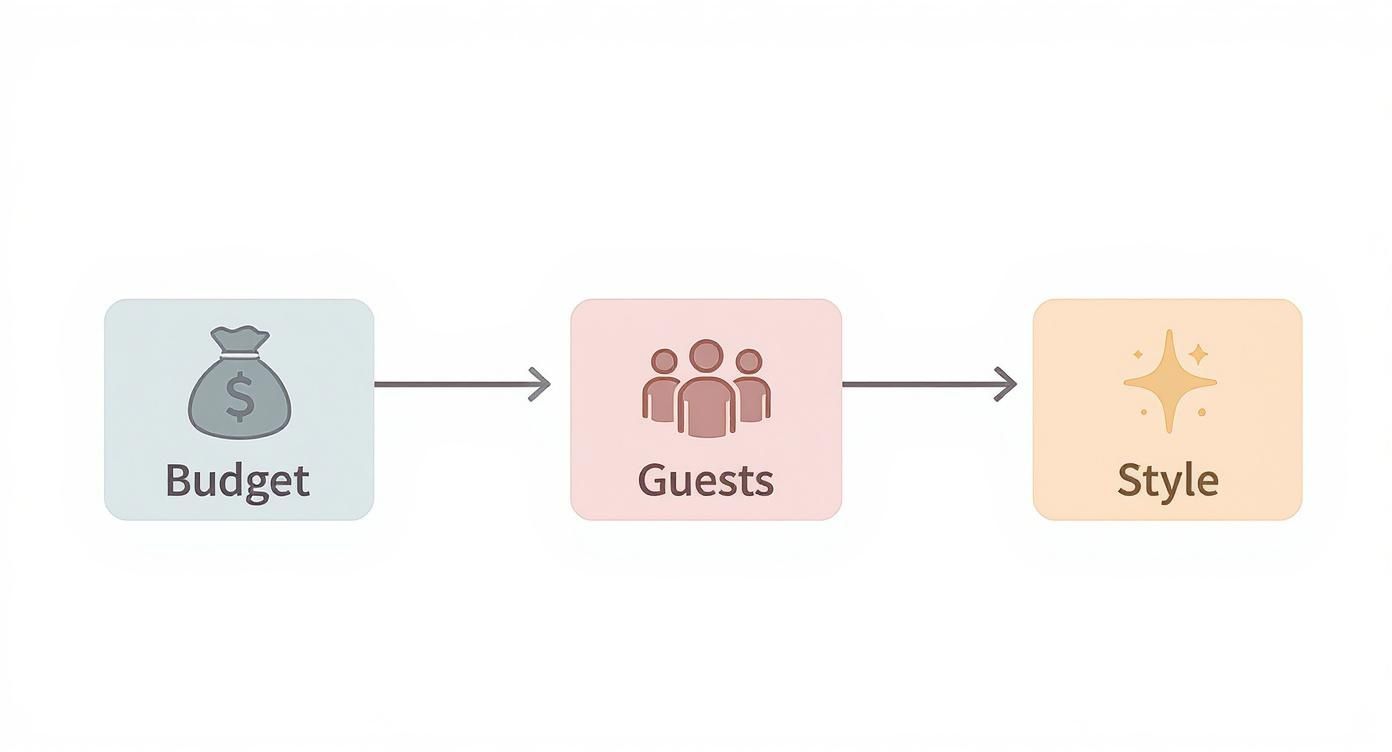
By establishing these fundamentals first, you ensure you're focusing your energy only on venues that are a realistic—and exciting—match for your wedding.
Exploring Popular Venue Aesthetics
Let’s delve into the most common venue categories. Each offers a unique atmosphere and comes with its own set of practical considerations. Visualizing your day in these different settings will help clarify your priorities.
Couples today are increasingly drawn to venues with a strong, built-in personality. The full 2025 wedding trends report on TheWedStay.com reveals that 62% of couples now prioritize venues known for their scenic beauty on social media. We're also seeing a 38% annual increase in demand for unique historic properties like mansions and art galleries. The takeaway is clear: couples want a venue with a story.
Historic Estates and Mansions
These venues offer pure, timeless elegance with features like grand staircases, ornate molding, and sprawling gardens. A major benefit is that the decor is largely built-in, which can save a significant portion of your styling budget and provide a stunning, ready-made backdrop.
However, that classic charm can come with limitations. Many historic properties have strict rules regarding approved vendors, decoration restrictions (open-flame candles are often prohibited), and even music curfews. You must inquire about modern necessities like air conditioning and accessibility, as they aren't always guaranteed in older buildings.
Rustic Barns and Farms
If you envision a relaxed, romantic, and personalized celebration, a barn venue could be perfect. These spaces are essentially beautiful blank canvases, offering high ceilings, warm wood, and an inviting atmosphere that feels less formal and more intimate.
The trade-off for this rustic freedom is often logistics. Many barns are "raw spaces," meaning you are responsible for bringing in everything—from tables and chairs to catering kitchens and, in some cases, portable restrooms and generators. While this requires more coordination, it also gives you complete control over your vendor team and allows for ultimate creativity.
Modern Industrial Lofts and Galleries
For couples with an urban-chic aesthetic, a converted factory loft or minimalist art gallery is an ideal fit. These venues provide an edgy, sophisticated vibe with exposed brick, polished concrete floors, and large windows, creating a dramatic setting that requires minimal additional decoration.
Like barns, these are often blank slates, requiring you to source most of your own rentals. A key factor to consider here is acoustics. High ceilings and hard surfaces can create significant echo, making it difficult for guests to hear speeches or music. Ask if the venue has an integrated sound system or if you might need to arrange for sound-dampening solutions.
- Expert Takeaway List:
- All-Inclusive Venues (e.g., Hotels): These are your "easy button." They bundle services like catering and rentals, which is ideal for a low-stress planning experience.
- Non-Inclusive Venues (e.g., Barns, Lofts): These venues offer total creative freedom but position you as the general contractor for your wedding, requiring more hands-on management.
Ultimately, the right venue won’t just host your wedding—it will feel like an extension of who you are as a couple. As you begin your search, keep asking yourselves: "Does this place feel like us?" That is the secret to knowing how to choose a wedding venue you'll cherish.
Mastering the Venue Tour: The Questions You Didn't Know You Needed to Ask
You’ve shortlisted a few venues online, and now it’s time for the site visit. This is where the vision becomes reality. The tour is your chance to experience the space, meet the team, and determine if the venue lives up to the dream.
Approach this not as a simple walkthrough, but as an interview. You’re not just admiring a pretty room; you’re entrusting this establishment with one of the most significant days of your life.
Going into a tour armed with smart, insightful questions is what separates a smooth planning process from one filled with costly, last-minute surprises. We'll go deeper than "What's your capacity?" to uncover the details that truly shape your wedding day experience.

This strategic approach will help you move from simply liking a venue to confidently choosing the right one, free of hidden red flags.
Uncovering the Financial Realities
The rental fee you see advertised is merely the starting point. The true cost is often buried in the fine print, and your first mission is to bring every expense into the light.
A venue's pricing structure can be complex. Between service charges, administrative fees, and taxes, an initial quote can easily increase by 20-30% or more. Asking direct questions about every charge is not being difficult—it’s being a savvy consumer. You need the complete financial picture to compare your options accurately.
- Key Financial Questions:
- "Can you provide a full, itemized proposal?" Never settle for a verbal estimate. Request a sample quote showing every tax, service charge, and gratuity, and ask for clarification on any line item you don't understand.
- "Is the food and beverage minimum calculated before or after taxes and fees?" This small detail can alter your final bill by thousands of dollars.
- "What are your overtime fees?" Know the cost per hour to extend your reception before you need to make that decision.
- "Are there any other service fees, such as cake-cutting or corkage fees?" Get specific to avoid any surprises.
Clarifying Vendor and Decor Rules
Every venue operates by its own rulebook, and you need to understand it before signing a contract. Some offer complete creative freedom, while others provide a strict list of vendors you must use. Neither is inherently wrong, but you must know which framework you're agreeing to.
An exclusive vendor list is non-negotiable. A preferred vendor list is more of a recommendation; you can typically hire off-list professionals, sometimes for a small fee. This is a critical factor in how you choose a wedding venue, as it impacts both your budget and your ability to personalize the day.
Vendor flexibility is one of the most significant factors in making a wedding feel truly unique. If you've already found a photographer or band you love, a venue with a rigid exclusive list is an immediate disqualifier, regardless of its beauty.
- Key Vendor & Decor Questions:
- "What is your vendor policy—exclusive, preferred, or completely open?" If it's exclusive, request the list and their pricing immediately.
- "What are your decoration rules?" Ask specifically about open flames, hanging installations, confetti, and sparklers.
- "When can my vendors access the space for setup?" A minimum of four to five hours is ideal for a full setup without causing stress.
Understanding the Nitty-Gritty Logistics
This final category covers the practical, less-glamorous details that ensure a seamless experience for you and your guests. It’s about planning for every contingency.
Don’t just look at the main event space. Walk the entire property. Assess the condition of the restrooms, the distance from the parking lot, and the flow between ceremony, cocktail hour, and reception areas. These are the details your guests will notice.
- Key Logistical Questions:
- "What is your cancellation policy?" Understand what you stand to lose if you must cancel or postpone.
- "Do you carry liability insurance, and are we required to purchase our own?" This is now a standard requirement at most venues.
- "What is the rain plan?" If any part of your day is outdoors, what is the backup plan, and when must the final decision be made to move indoors?
- "Is there a dedicated on-site coordinator, and what are their specific duties?" Clarify if their role is to manage the venue or to assist with your overall event coordination.
When you walk into a tour with these questions, you are no longer just a visitor. You are a planner in control. You will leave with the concrete facts needed to make a brilliant, confident, and regret-proof decision.
Read the Venue Contract Like a Pro
The moment you find "the one" is exhilarating. But before you sign that contract, it's essential to understand that this document is the single most important piece of paper in your planning process. It is the official rulebook for your wedding day and the ultimate protection for your investment.
Think of the contract as a detailed roadmap, not an obstacle. It outlines every promise, expectation, and "what-if" scenario in clear terms. Taking the time to scrutinize it now is your best defense against surprise costs and frustrating misunderstandings later.
This step is about securing complete peace of mind. Let’s translate the dense legal language into actionable knowledge.
Decoding the Critical Clauses
While every contract is different, they all contain a few non-negotiable sections that you must fully comprehend. These clauses govern your money, your rights, and what happens if unforeseen circumstances arise. Do not just skim them—read them, question them, and never hesitate to ask for clarification.
- Payment Schedule: This must clearly state your non-refundable deposit amount, the due dates for subsequent payments, and the final balance due date. Enter these dates into your calendar immediately.
- Force Majeure Clause: This clause explains what happens if an "act of God"—like a natural disaster or pandemic—makes it impossible to hold your wedding. It should specify if this allows for a penalty-free postponement or a refund.
- Cancellation Clause: This details the financial penalties if you need to cancel the event. Understand exactly what you would forfeit at different points in the timeline.
What Is Actually Included in Your Rental
The term “venue rental” can mean vastly different things. At one venue, the fee might include tables, chairs, linens, and staff. At another, it might literally just grant you access to an empty building. The contract must spell this out with zero ambiguity.
Never assume an item is included just because you saw it during the tour. If it is not explicitly listed in the contract—from the dance floor to the parking attendants—it is not guaranteed. This is a common area for hidden costs to appear.
Create your own checklist based on the contract to track what is included versus what you will need to rent separately.
- Staffing Details: Clarify if an on-site manager, security, and a post-event cleanup crew are included.
- Rental Items: Get a specific inventory of all included items, such as chairs, tables, linens, flatware, and glassware.
- Time Allotment: Confirm the hours for your event as well as the setup and breakdown windows for your vendors.
- Liability and Insurance: The contract should detail the venue’s insurance and specify your own insurance requirements.
By thoroughly reviewing these contractual details, you are not just booking a venue; you are building a solid, secure foundation for a flawless event.
Dreaming of a Destination Wedding? Here's How to Avoid the Headaches
Choosing a wedding venue from hundreds of miles away adds a unique layer of complexity to the process. The idea is incredible, but the logistics can feel daunting. This is your expert guide to navigating the destination venue search with confidence, ensuring you secure a breathtaking location without the logistical nightmares.
You are not alone in this dream. Destination weddings now account for approximately 17% of all weddings worldwide, with the market projected to grow from €42.8 billion in 2024 to €162.1 billion by 2029, according to data on RadicalStorage.com. This trend shows that couples are seeking more than just a party; they want a multi-day experience.
The Planning Trip vs. The Virtual Search
Your first major decision is how you will scout your venue. Do you need to book a dedicated planning trip, or can you manage the entire process virtually? The right answer depends on your budget, timeline, and comfort level.
There is no substitute for a dedicated planning trip. It allows you to experience the atmosphere firsthand, walk through the spaces, and meet vendors in person. However, if a trip isn't feasible, your success will hinge on technology and trusted local expertise. You'll rely on high-quality virtual tours, detailed floor plans, and extensive photo galleries. Crucially, this is when hiring a seasoned local wedding planner becomes non-negotiable.
- Expert Takeaway: A hybrid approach is often the most effective strategy.
- Conduct your initial research online to narrow your list to two or three top contenders.
- Then, book a single, highly focused trip to see only those finalists and complete your most important vendor meetings.
- This method maximizes your time and investment.
Put Your Guests First
Remember, your guests are investing significant time and money to celebrate with you. Making their experience smooth and enjoyable should be a primary factor in how you choose a wedding venue.
Focus on a location that simplifies travel and lodging. A stunning, remote villa loses its appeal if the nearest airport is three hours away and accommodations are scarce.
- Accommodations: Research the area for a mix of hotels and rentals to fit various budgets. Ask potential venues about discounted room blocks.
- Transportation: Consider how guests will travel between their lodging and the wedding events. Look for venues within walking distance of hotels or be prepared to arrange shuttles.
- Activities: Choose a destination that offers engaging activities for your guests. You are providing them with both a wedding and a mini-vacation.
Managing the Details from Afar
Planning a destination wedding involves a unique set of logistical challenges. This is another area where a great local planner proves invaluable.
- Vetting Local Vendors: Rely on reviews, portfolios, and video interviews. A local planner can provide a list of trusted, proven professionals.
- Marriage License Laws: Research the legal requirements for getting married in your chosen destination well in advance to ensure your marriage is legally recognized back home.
- International Payments: Inquire about preferred payment methods and factor in potential wire transfer fees and currency conversion rates.
Planning a wedding from a distance requires extra diligence, but the reward—an unforgettable experience for you and your loved ones—is well worth the effort.
Answering Your Biggest Wedding Venue Questions
Navigating the world of wedding venues can feel overwhelming. After years in this industry, I've heard every question imaginable from couples just like you. Here are expert answers to the most common inquiries to provide clarity and confidence as you make your final decision.
This is your cheat sheet for those last-minute "what if" moments. My goal is to demystify the venue selection process so you can choose a place you will absolutely love.
When Should I Really Book My Wedding Venue?
The short answer is: as soon as you possibly can.
Realistically, you should aim to sign your venue contract 12 to 18 months before your wedding date. This is especially critical if you are planning to marry during peak season (typically May through October) or have your heart set on a popular location.
The most in-demand venues book prime Saturdays nearly two years in advance. Waiting too long means you risk compromising on your date or losing out on your dream venue entirely. Securing your venue is the first major domino to fall; your entire planning timeline depends on it.
What's a "Reasonable" Price for a Wedding Venue?
Venue costs vary dramatically based on location, day of the week, and inclusions. For this reason, a "reasonable" price is not about a specific dollar amount but about overall value.
Do not focus solely on the rental fee. A venue with a higher fee that includes tables, chairs, linens, and an on-site coordinator could save you thousands compared to a "raw space" where every item must be rented separately. Always request a detailed, itemized proposal to understand the full financial picture. The ideal venue fits within the 40-50% of your total budget allocated for venue and catering combined.
Can I Bring In My Own Vendors?
This depends entirely on the venue's policy and is a critical question to ask.
- Exclusive Vendor List: You are required to use their pre-approved professionals. This can simplify planning but limits your choices.
- Preferred Vendor List: This is a recommendation. You can usually hire outside vendors, sometimes for a fee or with proof of insurance.
- Open Policy: You have complete freedom to choose your vendors.
A venue's vendor policy directly impacts your budget and the personal feel of your wedding. If you have already found a photographer or caterer you love, a venue with a strict exclusive list is an immediate deal-breaker.
What's the Plan if It Rains?
For any venue with an outdoor element, a rock-solid rain plan is non-negotiable. A professional venue will have a specific, designated indoor space that is just as beautiful and can comfortably accommodate all your guests.
- Crucial Rain Plan Follow-Up Questions:
- "Can we see the backup space?" Visualize it set up for your event.
- "When do we have to make the final call to move indoors?" Know the deadline (e.g., the morning of the wedding).
- "Is there an extra cost to use the backup space?" Some venues charge a "flip fee" to reset a room from a ceremony to a reception layout.
Knowing you have an excellent Plan B will provide immense peace of mind, allowing you to enjoy your day regardless of the weather.
Choosing your venue is a monumental step, and once it's done, the rest of your planning falls into place. By asking the right questions, you can find a space that not only offers a stunning backdrop but also serves as the perfect foundation for your entire celebration.
For couples dreaming of a destination wedding without the guesswork, Vallarta Wedding Planners connects you with the most celebrated and trusted vendors in Puerto Vallarta and Riviera Nayarit. We have done the vetting so you can focus on creating a beautiful, seamless experience. Explore our curated network of wedding professionals and let us help bring your vision to life.
Article created using Outrank